Predictive prevention · urban security · Italian field experience

XLAW®

The Italian experience in predictive prevention for predatory urban crime.

A documented research and field experimentation pathway focused on moving from post-event response to the anticipatory reading of the conditions that make predatory crime more likely.

Definition

Not simply a software product, but a documented operational and scientific experience.

What XLAW is

A predictive prevention method for urban security

XLAW® is the name of a technical and methodological experience developed to support the prevention of predatory urban crime through georeferenced predictive alerts, recurring criminal model analysis and selective resource deployment.

Scope

Recurring predatory crime

The method focuses on thefts, robberies, pickpocketing, scams and other urban events characterized by recurrence, spatial-temporal regularity and observable operating patterns.

What XLAW is

A technological and methodological invention for anticipating predatory urban crime.

XLAW® is a technological and methodological invention conceived and implemented to test, for the first time in Italy, an innovative approach to urban security based on the possibility of preventing widespread urban illegality through a predictive logic.

Technical-methodological protocol

Georeferenced predictive alerts

The system generates and strategically uses georeferenced predictive alerts of possible crimes, processed through a predictive model based on machine learning.

Beyond traditional prevention

Where risk is predicted, not where crime has already occurred

Unlike control or alarm systems that operate after the event, XLAW directs prevention toward places and times where risk is expected to reconfigure.

Applied research

Experimentation, verification and validation

The field experimentation, conducted across multiple cities and independently assessed, documented the possibility of making territorial control more dynamic, selective, precise and effective.

Public resources

More efficient prevention

The goal is not to increase controls indiscriminately, but to reduce the waste of resources and energy through a better operational awareness of risk.

XLAW shifts the strategic construct of territorial control from a reparative vision of damage to a probabilistic vision of risk.

Giacomo Di Gennaro, University of Naples Federico II
Paradigm

From hot spots to hunting reserves.

XLAW introduced a different interpretation of risk: not only places where past crimes clustered, but recurring configurations in which offender, victim, target, place, day and time form an observable trajectory.

Selectivity

Not the whole territory at the same time

Control is oriented toward the points and time intervals where risk configurations are more coherent and imminent.

Sequentiality

Following the evolution of risk

Operational action follows the likely sequence of the predatory phenomenon rather than generic social alarm.

Prevention

Before the event becomes visible

The aim is not only to react after damage, but to disrupt the criminal sequence before it materializes.

Key ideas

The concepts that keep XLAW relevant today.

The older website content is reorganized here into readable documentary capsules, preserving the substance while making the experience clearer and easier to navigate.

01

Predict in order to prevent

XLAW was developed to shift urban security from post-event response to anticipatory action before risk becomes damage.

02

Predictive alert

The core of the experience is not an alert after crime, but georeferenced strategic information that guides prevention in time and space.

03

Hunting reserves

The method moves beyond traditional hot spots and observes recurring configurations of place, offender, victim, target, day and time.

04

Selectivity and sequentiality

Prevention becomes more precise when resources are not deployed generically but follow the evolving sequence of risk.

05

No displacement

The experimentation also addressed crime displacement, documenting a reduction of the phenomenon without migration to alternative areas.

06

White box, privacy and transparency

XLAW documents method, sources and results and is not based on individual profiling, biometric identification or scoring of people.


Privacy and responsible AI

XLAW does not profile people: it reads territorial and operational conditions.

A defining feature of XLAW is its non-person-based design: the method is not intended to identify, classify or profile individuals, but to read aggregate risk configurations, spatial-temporal sequences and operational conditions useful for prevention.

No individual profiling

No scoring of people

XLAW does not assign dangerousness scores to citizens, does not use biometrics and does not build individual profiles.

White box

Documented and verifiable method

The experience is presented through method, sources, results, publications, validations and public evidence, avoiding opaque or non-explainable logic.

AI Act and privacy

Proportionate and risk-based approach

Without claiming formal certification, XLAW is aligned with a modern view of AI: proportionality, transparency, human oversight, minimisation of impact on individual rights and a risk-based orientation.

Genesis, principles and results

From urban deviance to selective and sequential prevention.

The project emerged from long-term study of urban deviance. Theft, robbery, snatching, pickpocketing, fraud and other predatory crimes were observed as phenomena showing recurrence, territorial persistence and reconfiguration across time and space.

Origin

Multidisciplinary research

The model combines operational observation, criminology, urban context analysis, social dynamics, machine learning and deterrence theory.

Method

Beyond hot spots and retrospective analysis

XLAW moves beyond simply reading places where crimes have already occurred, focusing instead on the conditions that make a criminal pattern likely to reconfigure.

Operations

Selective and sequential controls

Operators are supported by strategic information that enables more precise, dynamic and risk-aware deployment.

Deterrence

Reducing opportunity, not only punishing afterwards

The results fit within a deterrence logic: increasing the probability of disrupting the criminal design may move a system from a high-violation equilibrium to a lower-violation equilibrium.

Recognition

SMAU Digital Innovation Award 2018

SMAU Digital Innovation Award 2018 - XLAW

XLAW was recognised as a digital innovation case for the application of artificial intelligence to the prevention of predatory crime and urban security. The SMAU recognition strengthens the public traceability of the experience and its value as a documented Italian field experimentation.

Open the archive of sources and recognitions →

Field trials

An Italian operational field experimentation.

The field trial was conducted across multiple urban contexts, comparing actual events with predictive alerts generated by the system.

City

Naples

Origin of the research, development and initial operational experimentation.

City

Salerno

Extension of the experimentation into a different urban context.

City

Prato

Verification of transferability to another territorial setting.

City

Venice

Application in a complex urban and tourist environment.

City

Parma

Additional operational verification of method and protocol.

City

Modena

Application documented also through public media evidence.

Results

Reported prediction accuracy in the field experimentation.

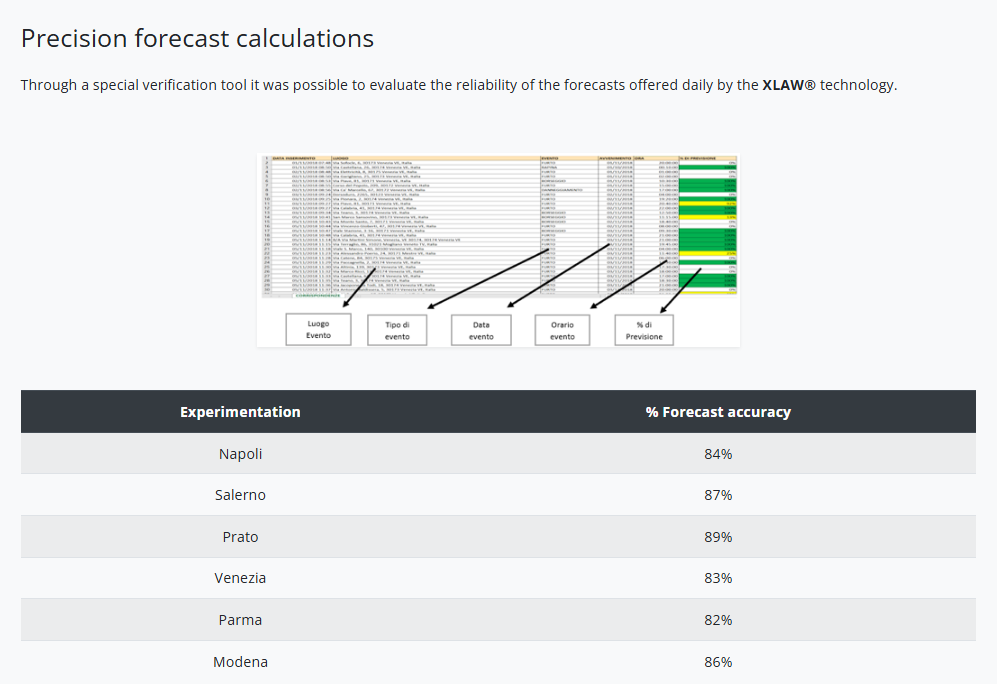
The documentary publication reports a comparison between actual events and predictive alerts generated within the same daily period.

City Reported predictive accuracy Context
Naples84%urban field trial
Salerno87%urban field trial
Prato89%urban field trial
Venice83%urban field trial
Parma82%urban field trial
Modena86%urban field trial
Visual evidence

The XLAW field trial in readable visual boards.

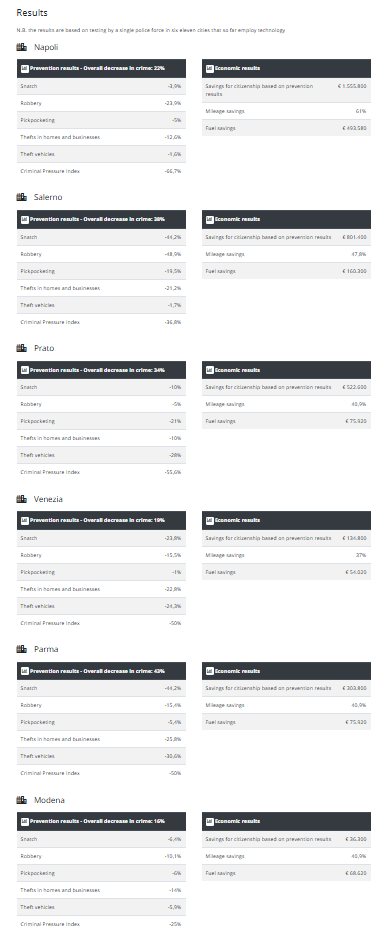
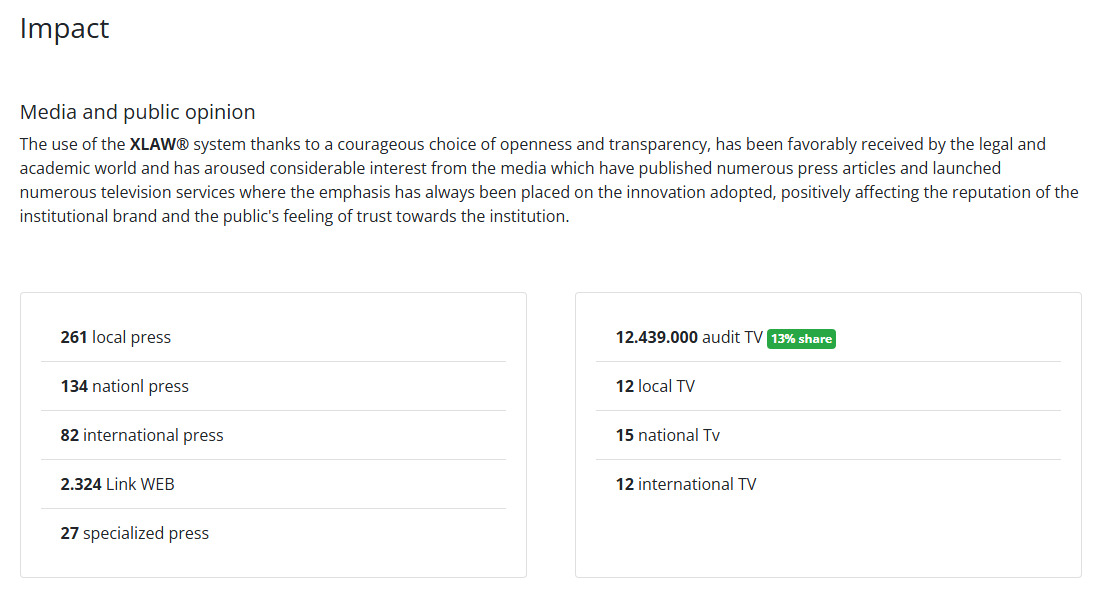
The documentary images summarize the cities involved, verification method, predictive accuracy, results, displacement, participation and media impact.

Documentary evidence

Foundational book, DOI publication and public sources.

XLAW should be read as a documented field experience: book, DOI publication, validations, trials, press coverage, videos and public materials form its historical and scientific evidence base.

Foundational book

Sicurezza 4P

The study behind XLAW software for predicting and preventing crime.

The book reconstructs the theoretical and operational roots of the method, including the hunting reserve theory and the transition from post-event response to preventive precision.

View / buy the ebook →

DOI publication

Predictive Policing for Urban Security

The official Italian field experimentation.

A documentary synthesis of method, protocol, field results, cost-benefit implications, conclusions and references.

Open DOI 10.5281/zenodo.19656055 →

Timeline

A trajectory of research, field testing and public recognition.

1999–2000

Start of the research work on predatory urban crime and territorial control strategies.

2004

Initial operational experimentation and early applications of the prevention paradigm.

2013

Academic dialogue and consolidation of the criminological foundations.

2018

Public recognition and SMAU Digital Innovation Award.

2019

Publication of Sicurezza 4P and consolidation of the foundational documentary basis.

2021

Publication of the Italian field experimentation synthesis with Zenodo DOI.

Today

XLAW remains a historical and scientific reference for the shift from events to conditions in predictive urban security.